
Deep Review is a Google AI system that reads a long document, checks its logic and claims, and returns a detailed critique. Google Research opened it to the public on October 14, 2026, after testing it on more than 16,000 scientific papers submitted to four computer science conferences (STOC, ICML, NeurIPS and ICLR). Each person gets two free reviews per week, and anyone who needs volume connects a Gemini API key. The details are in the announcement by Rajesh Jayaram and Vincent Cohen-Addad.
For marketing and SEO people, the interesting part is the second half of the announcement: Google says the tool also works on design documents, presentations and contracts. But for now the product accepts PDF and plain text only. That gap between what the headline promises and what the upload form accepts decides whether it is worth testing today.
What is Deep Review and how does it work?
Deep Review is an agentic system: several AI agents working in sequence instead of one giant prompt. Google explains that a single call to a model tends to fail on long documents because it runs out of reasoning budget, misses dependencies between distant sections and accepts delicate claims without scrutinizing them. The pipeline has four stages:
| Stage | What happens |
|---|---|
| Segmentation | An agent splits the document into logical parts (introduction, method, experiments), which may overlap but must cover all the content |
| Adaptive budgeting | The system measures information density and gives more compute to dense sections, such as a mathematical proof, than to an introduction |
| Parallel verification | Specialized agents examine each segment at the same time, each with access to the full document to follow cross-references |
| Synthesis and external checks | An agent consolidates the reports, reruns logic checks if needed and consults external sources to reduce hallucination |
Source: Google Research. The system started as the Paper Assistant Tool (PAT), an experimental tool for researchers to stress-test manuscripts before submission deadlines, and now runs on the Gemini 4 Argon model.
Why did Google build a review tool now?
Google built Deep Review because AI-assisted production of technical text grew faster than human capacity to check it. The announcement calls this the validation bottleneck: information is generated faster than anyone can review it rigorously.
Google’s example is peer review of scientific papers. In 2026, the three largest AI conferences (ICLR, NeurIPS and ICML) received more than 74,000 submissions, over three times the roughly 23,000 of 2023.
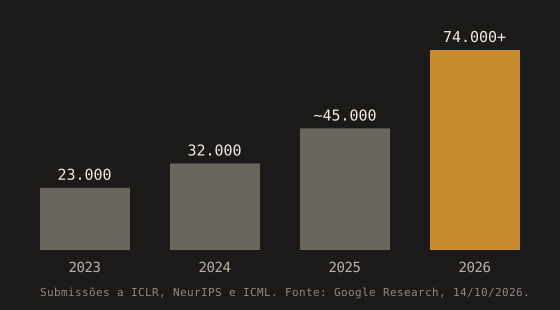
Chart rebuilt from the values in the Google Research announcement. The 2025 value is approximate in the source.
The same bottleneck exists outside academia. It is what I described when covering why coding agents produce more code, but not more software: producing got cheap, checking did not.
What kinds of documents does Deep Review review?
Google names three uses beyond scientific papers. For design documents, the tool looks for unstated architectural assumptions and edge cases. For presentations, it checks that slide flow is logical and that the bullet takeaways match the charts. For legal and financial documents, it checks consistency between clauses and tables, flags ambiguous terms and compares claims against evidence.
But read what Google writes about formats: Deep Review accepts PDF and plain text at first, and multi-file support is “coming soon”. The opening line of the announcement mentions Google Docs and presentations, but the list of formats does not include them. If you work in Docs or Slides, you need to export to PDF before uploading.
For Antigravity, Google also released the Teamwork Deep Document Review Pattern, a multi-agent review pattern invoked with the /teamwork-preview command. I have not tested it, and the announcement gives no numbers for it.
How much does it cost and what happens to my document?
Deep Review is free for up to two reviews per week per user. Beyond that, programmatic access through the API uses your Gemini key, and the cost depends on your plan with Google (the announcement gives no price).
On privacy, Google states two things. Uploaded documents are never used to train, fine-tune or improve Google models. And they are stored for one year, solely to display them to you in the Deep Review interface. For a client contract or a report with sensitive data, the one-year retention matters more than the promise not to train. Check your company’s policy before uploading anything.
Can you trust an AI review?
You can trust it as a second reading, not a verdict. Google itself says the tool leaves “higher-level judgments” to humans, and the positive reactions it cites come from authors who used it before submission, with no accuracy figures published in the announcement. There is no false-positive rate and no comparison with human reviewers. What we know is that 16,000 authors agreed to use it, not how often it is right.
When I worked at Banco do Brasil, no document left without a second read by someone who had not written it. Deep Review can fill that seat when you have no such colleague, but it is still a reading, and the person signing the document is you.
What should you test on Monday?
A cheap test fits in one afternoon:
- Pick one of your own documents, already closed and with no sensitive data, such as an old proposal or an SEO audit report without a client name.
- Export it to PDF and upload it. Remember the free limit is two reviews per week, so do not spend both on the first attempt.
- Mark each finding as valid, invalid or doubtful. That scoreboard is your measure of trust in the tool, better than any launch promise.
- Check whether it found something you already knew was weak. If it only finds the obvious, the gain is small. If it finds an inconsistency between a table and the text that you missed, it has already paid for itself.
- Only then decide whether it belongs in your workflow before sending to a client.
If your work involves producing content with AI, connect this to what I already wrote about saving tokens when using AI and the guide to appearing in ChatGPT and other AIs: reviewing what the AI wrote is the half of the process that usually gets left out.
Summary: what Deep Review delivers and what is still unknown
Deep Review is a long-document reviewer in four stages (segmentation, adaptive budgeting, parallel verification and synthesis), open to the public since October 14, 2026. It gives two free reviews per week, accepts PDF and plain text, keeps files for one year and does not use them to train models, according to Google. It was validated on more than 16,000 academic conference submissions, but the announcement publishes no accuracy rate, and its use on contracts, presentations and design documents is a Google claim with no performance data. The best first step is a test with an old document containing no sensitive data, counting how many findings make sense.