
Main content is any part of a page that directly helps the page achieve its purpose, and Google now says in writing that the quality of that content is “one of the most critical factors” for assessing page quality. The line appears in the documentation Creating helpful, reliable, people-first content, which shows “Last updated 2026-10-01 UTC”. Barry Schwartz spotted and reported the change on Search Engine Land on October 2, 2026.
For anyone making SEO decisions, the gain is practical: there is now an official list of what Google counts as main content and of how quality raters judge it.
What does Google call main content?
Main content is any part of the page that directly helps the page achieve its purpose. According to Google, that depends on the page’s primary intent, and it can include five things:
| Type | What Google describes |
|---|---|
| Primary text and media | Main text, articles, images, audio or video on the page |
| Interactive features | Calculators, online tools, games, search functionality |
| User-generated contributions | Forums, reviews, comments or uploaded media, when they fulfill the page’s purpose |
| Tabbed or expanded sections | Information behind tabs, such as specifications, safety notes or reviews |
| Titles and headings | The visible title and headings that summarize the topic |
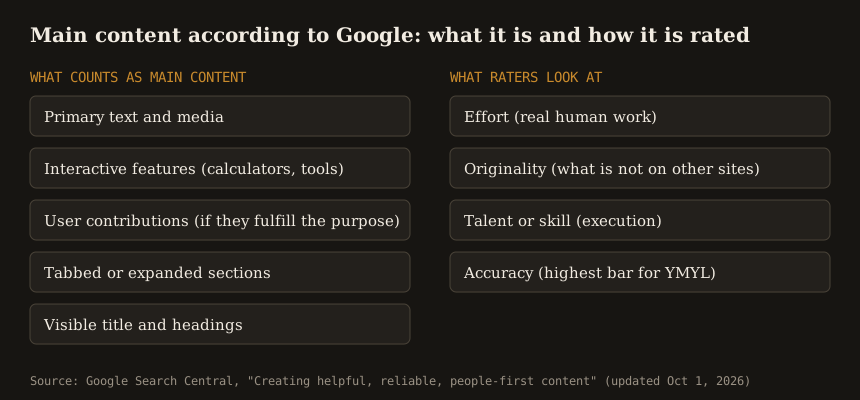
Two details matter. First, the list includes tools and content hidden in tabs: a calculator on a finance site counts as much as the text around it. Second, comments and reviews only count when they fulfill the page’s purpose. On a page about a specific user question, the discussion is the content. On a product page, the comment block may be secondary.
How do quality raters judge main content?
By four attributes that Google lists in the documentation: effort, originality, talent or skill, and accuracy.
- Effort: how much human work went into the content or the systems that produce it. Google gives examples of high effort (original analysis, manually translating a poem, a custom interactive map) and of little to no effort (pages generated automatically from feeds, or large amounts of generative AI text without manual oversight or curation).
- Originality: whether the content offers information or perspectives that are not already available on other sites.
- Talent or skill: whether the execution shows the skill needed for a satisfying experience, such as clear writing, well-produced video or tools that work. Google adds that not all content requires specialized expertise: someone sharing a new way to clear snow from a driveway does not need credentials.
- Accuracy: informational pages must be factually accurate. For YMYL topics (those that can significantly affect people’s lives or well-being), content must be highly accurate and consistent with expert consensus.
What changes for people who write with AI?
The sentence that weighs most for anyone producing at scale comes from the documentation itself: attribution or giving credit to other sources does not replace the need for original effort. Summarizing three articles and linking all three creates neither effort nor originality.
That fits Google’s guidance on AI: generating large amounts of text without oversight or curation falls under little to no effort. Search Engine Land notes that Google also changed its AI-generated content document around the same time, but says it cannot confirm a link between these changes and the spam update currently rolling out. I will not claim one either, since Google has not stated it.
I use AI in my own workflow and see no problem in that. The problem is publishing whatever the AI returns without adding anything it did not have, and that is exactly what the effort criterion describes.
How do you audit your pages with these criteria?
Take the 10 most important pages on your site and ask six questions: one per attribute plus two about structure.
- Purpose: in one sentence, what is this page for? If you cannot say it, a rater will not be able to either.
- Main content in the right place: is what fulfills the purpose visible early, or is it behind a banner, a popup and an ad block?
- Effort: what on this page exists only because someone worked on it? Own data, tests, original photos, a tool.
- Originality: if this page disappeared, would the reader lose something they cannot find elsewhere?
- Execution: is the writing clear, does the tool work, does the video load?
- Accuracy: do the numbers have sources? On a YMYL topic, did an expert review it?
A page that fails on effort and originality at the same time is a candidate to be rewritten, merged with another or removed. My rule is simple: if a page is only a summary of other sites, it is not content I would defend in front of a rater. This ties in with topical authority: a few strong pages on a topic beat many weak ones.
Does this affect rankings directly?
Google says raters do not control rankings. In the same documentation, it compares rater data to feedback cards at a restaurant: they help Google know whether its systems are working, but are not used directly in the ranking algorithms. Google also says reading the guidelines may help you self-assess your content.
So treat the list as a ruler, not a measurable ranking factor. It shows what Google wants to recognize as a good page, and it is a good way to decide where to spend production hours. On the AI side, the same thinking applies to getting cited: see the guide to showing up in ChatGPT and the post on what GEO is. For the basics of producing text, there is the post on SEO-friendly content that converts.
Summary: what to do on Monday
- Open the Google documentation and read the “Main content” section. It takes five minutes.
- List your 10 most important pages and answer the six questions above for each.
- Flag the pages that are summaries of other sources and decide: add your own data, merge or remove.
- On YMYL pages, check the source and expert review of every number.
- For AI-assisted content, define who reviews it and what the human adds before publishing.
Want an audit of your main pages using these criteria? Talk to me.