
That problem your company fixed a decade ago might be coming back right now. Not on classic Google, where it had already faded, but inside an AI answer about your brand.
That is exactly what happened to a grocery chain in the US Midwest, in a case reported by Anthony Will, CEO of Reputation Resolutions, on Search Engine Land on July 14, 2026. The chain is his client. The lesson applies to any business, from a supermarket to the restaurant down my street in Almada.
What happened to the grocery chain?
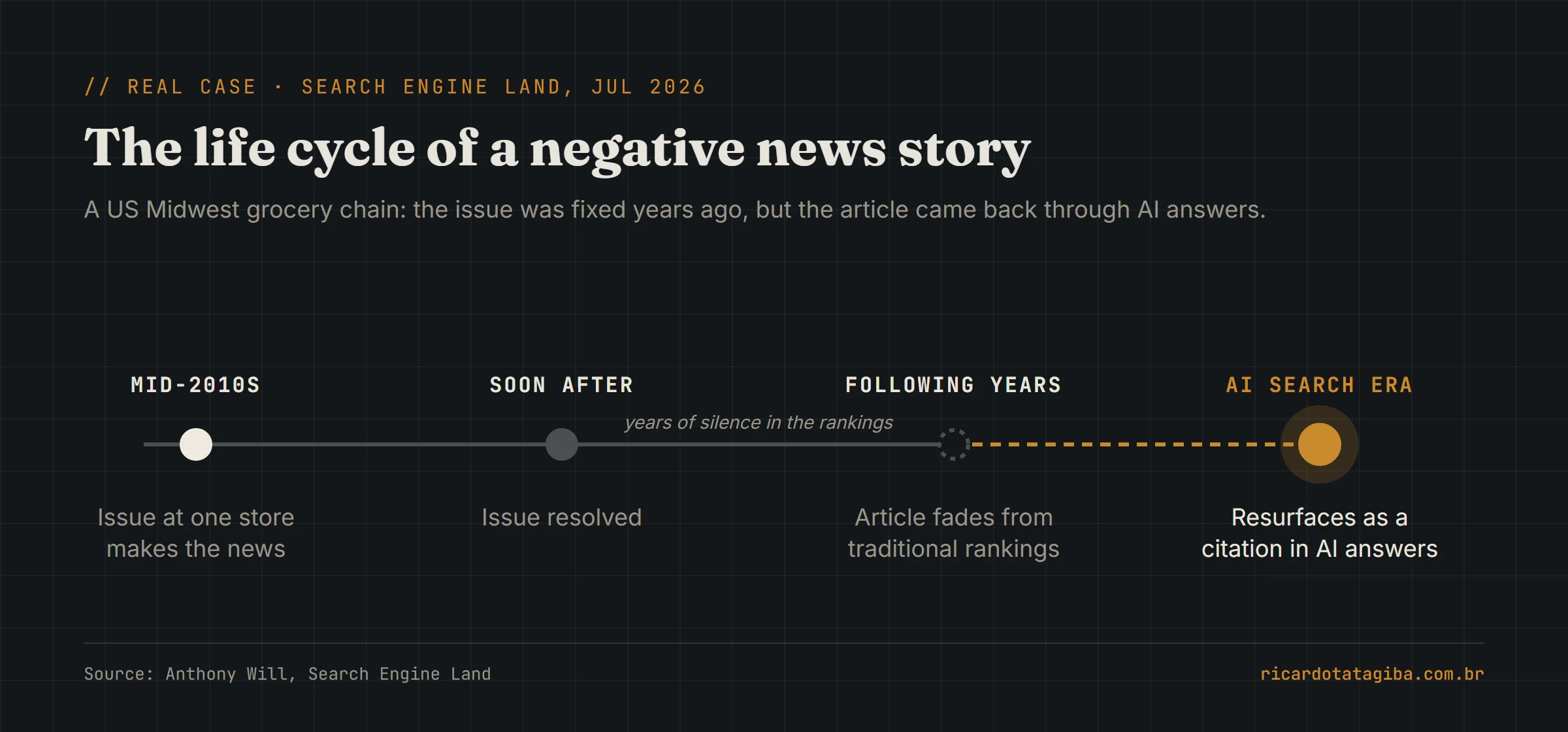
A negative news story about a single store, published in the mid-2010s, started being cited again and again in AI answers about the whole company.
The context: the chain has been growing for more than two decades. The story covered a customer service issue at one location, which was resolved shortly afterward. Over time, the article faded from public attention. Mission accomplished, by the old reputation management playbook.
Then AI Overviews arrived (the AI-generated summary Google shows at the top of search results). According to Will, seemingly overnight the article became a recurring source in AI-generated answers about the business. In his words, “a single, outdated news story began shaping how AI systems described a company whose reputation had long since moved on.”
Why does AI cite a story Google had already buried?
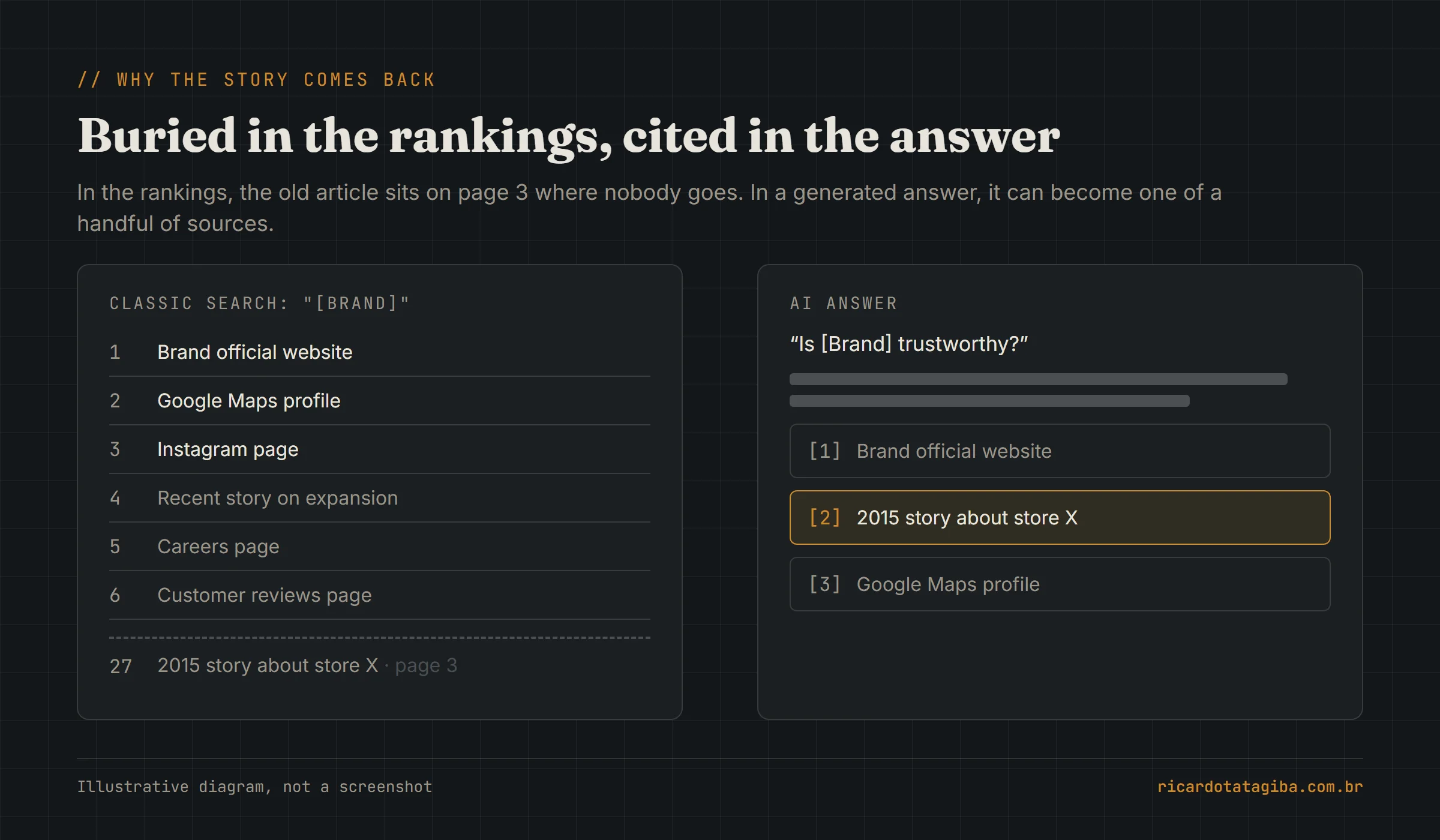
Because AI does not need a page to rank on page one to use it as a source. It looks for text that answers the question, and a news article about “a problem at store X” answers “is this company trustworthy?” very well. Will puts it this way: media coverage carries strong authority signals, and AI systems may keep treating a negative article as a reliable source long after the underlying issue is resolved.
The classic reputation strategy was to push bad content down with good content: optimized profiles, social media, microsites. It worked because almost nobody goes past page one. In a generated answer, that hierarchy flattens: the old article can become one of a handful of cited sources, side by side with your own site.
And no, AI does not discard old content by default. Ahrefs’ study of almost 17 million cited URLs shows assistants prefer slightly fresher content than organic Google, but the average age of what they cite is still 2.9 years.
How old is the content each AI tends to cite?
The figures below come from Do AI Assistants Prefer to Cite “Fresh” Content?, by Ryan Law and Xibeijia Guan (Ahrefs, July 28, 2025), which analyzed 16.975 million cited URLs. Age is measured in days since publication.
| Platform | Average age of cited content |
|---|---|
| ChatGPT (citations) | 958 days |
| Copilot | 1,056 days |
| Gemini | 1,118 days |
| Perplexity (in-text citations) | 1,166 days |
| Google AI Overviews (top 3 citations) | 1,432 days |
| Google organic (SERP) | 1,416 days |
| Average of ChatGPT, Perplexity, Copilot and Gemini | 1,064 days |
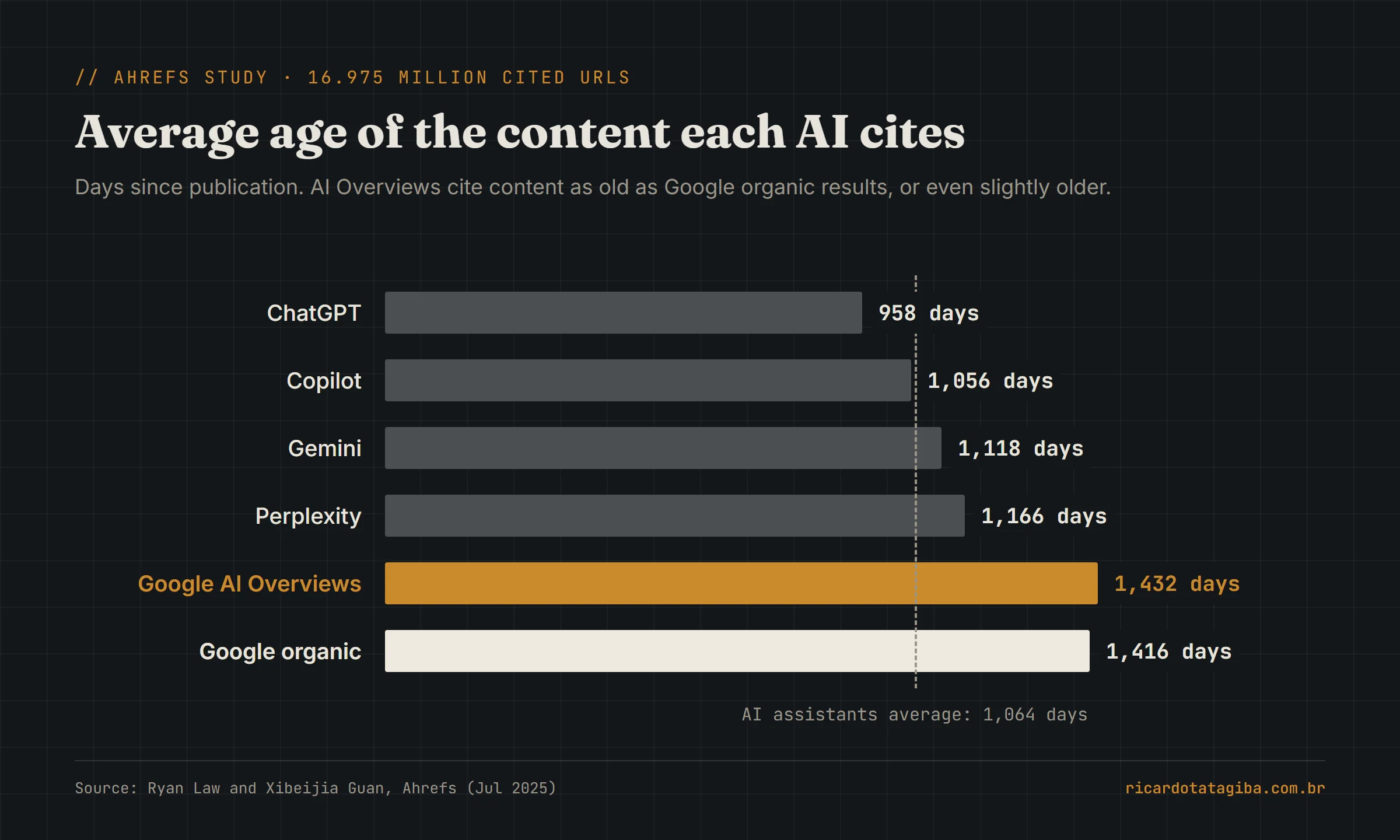
Notice the detail that matters most for the grocery case: AI Overviews cite content slightly older than organic search does (1,432 vs 1,416 days). The very surface that revived the story is the one least sensitive to freshness.
That kills the idea that “old news dies on its own.” It only leaves the stage when something better and more citable takes its place.
How do you know if your brand has this problem?
Ask the AIs what a customer would ask, and look at the sources that show up. Checking classic Google alone is not enough, because that is where the problem already looks solved.
Will recommends spending a few hours every month typing queries about your brand into various AI search engines. It is basic GEO (optimizing content to be cited in AI answers), and the most common mistake is the opposite: the brand tracks rankings and nobody reads the citations. If you have not mapped where your company shows up yet, start with the guide to showing up in ChatGPT.
Questions I recommend testing on ChatGPT, Perplexity, Gemini and AI Overviews:
- “Is [Brand] trustworthy?”
- “Does [Brand] have complaints?”
- “Is it worth buying from / eating at / hiring [Brand]?”
- “What happened with [Brand] in [city]?”
Write down every cited source, its publication date, and whether the fact is still true.
Checklist: how to audit and neutralize old mentions
There is no button to delete an AI answer. What you can work on are the sources. Combining the original article’s recommendations with what Google’s documentation allows, the playbook looks like this:
| Step | What to do | Tool or resource |
|---|---|---|
| 1. Monitor | Run the questions above monthly and log the cited sources | Otterly.ai, Mangools, Ahrefs Brand Radar (cited by Will) |
| 2. Classify | Separate true, current mentions from outdated or resolved ones | A simple spreadsheet |
| 3. Request an update | Contact the publisher asking for an update note or removal | Will mentions removenews.ai, a free tool that drafts the request and finds the editor’s contact |
| 4. Clean the index | If the page was removed or changed and Google still shows the old version, request a refresh | Google’s Refresh Outdated Content tool |
| 5. Create a better source | Publish citable content: case studies, first-party data, a clear statement | Your blog and niche outlets |
| 6. Diversify | Get featured on relevant publications so AI has more than one version of the story | Op-eds, interviews |
| 7. Respond fast | In a new crisis, clarify the controversy before the article becomes a widely cited source | Official statement page |
One caveat on step 4: according to Google’s own help page, the tool is for content that was deleted from the source site but still shows up in search. It does not remove an article that is still live.
In the grocery case, Will’s answer was step 5: original case studies and expert insights on the chain’s growth, published on reputable, longstanding media outlets. He also notes that traditional reputation and digital PR tools, such as Semrush and Surfer, are still useful.
Steps 5 and 6 are classic reputation work with a new target. The response and positive-content playbook is in the post on recovering from negative brand mentions.
What does this change in reputation management?
It changes the goal. Before, the goal was to hide the bad content. Now, the goal is to make sure that when AI builds the answer, it has better and more recent sources to cite.
This ties directly to topical authority: AI cites whoever covers the subject well. If the only page talking about “customer service at store X” is a 2015 news story, it wins by default.
Back in my Banco do Brasil days I learned that customers quickly forget a problem that was solved, but they remember a badly explained one forever. AI works the same way, only with an archive-grade memory. If you want the logic behind it, the post on what GEO is is a good starting point.
FAQ
Does AI always prefer recent content? No. According to Ahrefs, assistants cite content 25.7% fresher than organic Google, but the average is still 2.9 years. AI Overviews cite content 16 days older, on average, than classic search.
Can I ask Google to remove a story from an AI answer? There is no specific request for that. The path is to act on the source: an update or removal by the publisher, plus new, citable content on your side.
Are small businesses at risk too? Yes, maybe more. With few pages talking about the brand, a single old story carries far more weight in the answer.
Want to know what AI is saying about your brand today? Get in touch and I will show you the sources shaping that answer.