
Meta unveiled a groundbreaking artificial intelligence system capable of turning thoughts into typed text with up to 80% accuracy. The technology, however, still depends on a bulky, non-portable brain scanner and only works under controlled lab conditions.
A Breakthrough in Brain-Computer Communication
Developed in partnership with the Basque Center on Cognition, Brain and Language (BCBL), the study involved 35 volunteers. Using magnetoencephalography (MEG) and electroencephalography (EEG), researchers recorded brain activity while participants typed sentences. Based on that data, an AI model was trained to reconstruct the sentences from brain signals alone, reaching up to 80% accuracy decoding characters captured via MEG — double the performance of traditional EEG-based systems.
This breakthrough builds on Meta’s earlier research into decoding images and speech from brain activity, now expanding into generating full sentences. The potential of this technology opens new possibilities for non-invasive brain-computer interfaces, which could benefit people with communication disabilities.
How Does Brain2Qwerty Work?
Brain2Qwerty is what Meta named the system that captures magnetic signals generated by the brain while the user thinks of words or sentences. Using an MEG scanner, which records around 1,000 brain images per second, the AI identifies the moments when thoughts convert into text.
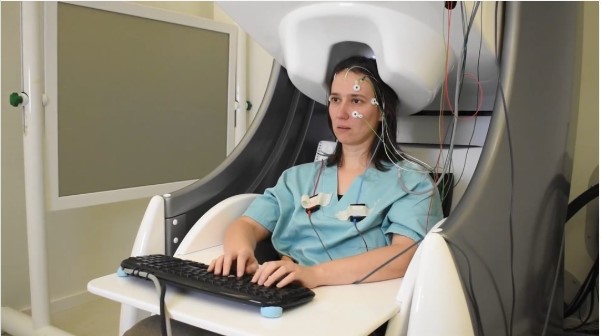
The technology uses deep learning to map brain signals onto keystrokes. Trained on thousands of characters typed by participants, the model learns to recognize brain patterns associated with different letters and words, resulting in an accurate conversion of thought into text displayed on screen — the same kind of pattern-mapping that underlies the shift to grounding as the future of organic traffic.
What Are the Challenges Facing Brain2Qwerty?
Despite being a promising breakthrough, the technology faces significant obstacles that keep it from everyday use. The main ones include:
- Size and cost: The MEG scanner weighs about half a ton and costs roughly $2 million, putting it out of reach for the general public.
- Lack of portability: The equipment is the size of a refrigerator and requires a specialized room to operate.
- Sensitivity to movement: Small head movements can compromise the system’s accuracy.
- Controlled environment: Optimal operation requires a magnetically shielded room to minimize outside interference.
The Future of Brain-Computer Interfaces
While still far from practical use, Brain2Qwerty marks an important step toward neural communication. Down the road, this technology’s evolution could drive advances in neuroscience and in assistive devices for people with motor limitations or speech difficulties.
Meta continues investing in refining this interface, suggesting that the fusion of artificial intelligence and neuroscience could redefine human-computer interaction in the decades ahead. If these challenges get solved, converting thoughts into text could become an everyday reality, transforming how we communicate and interact with technology.
Update: in 2026, Meta announced Brain2Qwerty v2, with an average accuracy of 61% (reaching 78% for its best participant) and trained on roughly 22,000 sentences, a direct evolution of the system described above.
Brain2Qwerty proves it’s possible to decode thought into text with meaningful accuracy (80% in the original study’s best-case scenario), but the cost of the equipment (around $2 million) and the need for a shielded room keep the technology confined to research settings for now.
Just as Brain2Qwerty relies on a deep learning model to translate brain signals into meaning, search engines today rely on similar models — vectors and embeddings — to translate the intent behind a query into meaning. To understand how this shift is impacting SEO, see the shift to semantic SEO and what vectors mean for your strategy.