
Google released more spam updates in 2026 because far more new content is entering the index, and a high share of that content is spam. That was the explanation given at Google Search Central Live Deep Dive Europe, a three-day event in Barcelona. The Search team also said it now uses AI to catch more cases, and Gary Illyes, an analyst at Google, left a warning: scaled content is becoming a bigger problem than link spam.
John Campbell published the day 3 recap, from October 2, on We Are Roast, and Barry Schwartz picked it up on Search Engine Roundtable. Nacho Mascort, a Spanish SEO consultant who was in the room, posted the slides on X and wrote a long analysis on his blog.
What did Google say about spam updates in Barcelona?
Spam updates became more frequent because the volume of new content grew, according to Google. The points recorded in the We Are Roast recap and on Search Engine Roundtable:
- A high percentage of content is spam, and that is what spam updates target.
- There have been more updates recently because there is much more new content.
- The team now uses AI to catch more examples of spam.
- “AI slop” (AI content produced in bulk and without care) is increasing, which means more poor content in Discover. The remark is attributed to Eric Murillo, one of the speakers.
- User feedback is the raw material for new spam filters.
- Google filters out 40 billion spam pages a day.
The last number is not new. The How Search Works page already says Google’s systems find “40 billion spammy pages every day”, and that the fight relies on machine learning and large language models. What is new in Barcelona is the context: Google tied the frequency of updates to the volume of content and said plainly that AI is on the detection side.
The most recent update in this cycle was the September 2026 spam update.
Why does Google keep changing how it assesses quality?
Google keeps changing its quality assessment for three reasons, presented by Gary Illyes:
- Content formats multiplied. Search moved beyond ten blue links and now shows much more media. Each format needs its own way of measuring quality.
- The amount of content grew. There are many more pages and sites than before.
- Content problems change. This is spam proper: cloaking (showing one page to the bot and another to the user), doorway pages (pages created only to rank), scraped content, link spam and hacked sites.
In the slides Nacho Mascort published, Google shows the scale of the second point: for every result for “naranja” (orange, in Spanish) in 2000, there are about 20,000 in 2025. Mascort himself notes he found no public source for that figure, only the slide. Another slide has 2023 numbers Google already publishes: 719,326 search quality tests, 124,942 side-by-side experiments, 16,871 live traffic experiments and 4,781 launches.
What did Gary Illyes mean by “scaled content”?
Scaled content is the production of many pages with little or no value of their own, usually through automation, mainly to take up space in search. It is one of the categories in Google’s spam policies, and generative AI made this kind of production cheap.
According to the We Are Roast recap, Gary said this problem is becoming bigger than link spam. The line matters because bought links were, for many years, the number one target of penalties. I have worked in SEO since 2014 and spent a good part of that time explaining to clients why not to buy links. The conversation now is a different one: how many pages a site publishes without anyone putting work into them.
John Campbell closed his recap with his own forecast, not Google’s: expect more spam updates and new thresholds, with scaled, low-quality content as the main risk.
How does Google define quality?
Google defines quality as the extent to which a person put effort, originality, talent, skill and accuracy into creating content. That was the definition on the “What is Quality?” slide in Barcelona, and it rests on the four pillars of the quality rater guidelines.
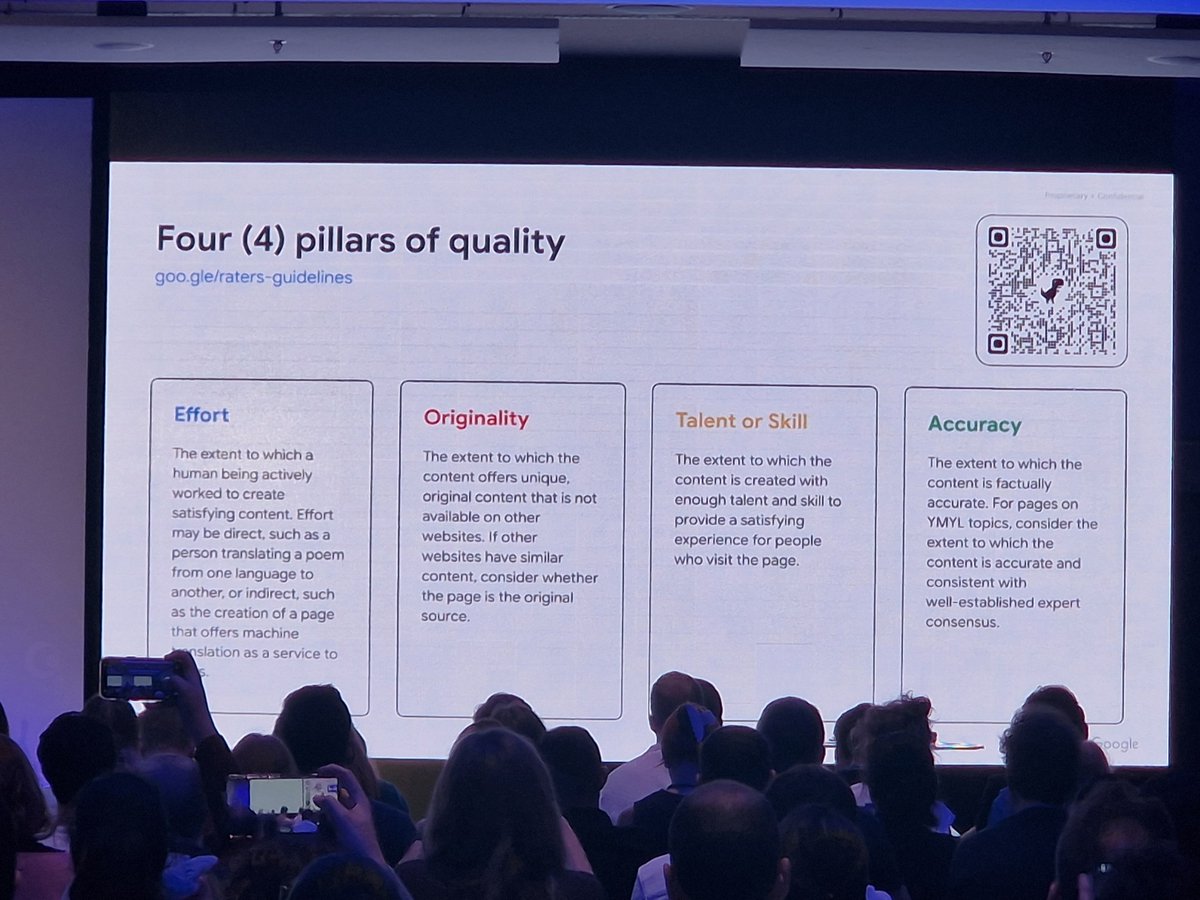
| Pillar | What the slide describes |
|---|---|
| Effort | How much a person actively worked to create satisfying content, directly (translating a poem) or indirectly (building a page that offers machine translation as a service) |
| Originality | Whether the content offers something not available on other sites. If other sites have similar content, whether this page is the original source |
| Talent or skill | Whether the content was made with enough talent and skill to give visitors a satisfying experience |
| Accuracy | Whether the content is factually correct. On YMYL topics (those affecting health, money or safety), whether it is consistent with expert consensus |
The same criteria went into writing in Google’s helpful content documentation last week, which I covered in the post on main content and page quality. In Barcelona, Duy Nguyen of Google summed up the position on AI this way, according to We Are Roast: “the point is the quality, not who wrote it”.
What is commodity content?
Commodity content is interchangeable text: if you swapped the site’s brand for a competitor’s, nothing would change. The term appeared on a Google slide shown in Barcelona, with side-by-side examples.
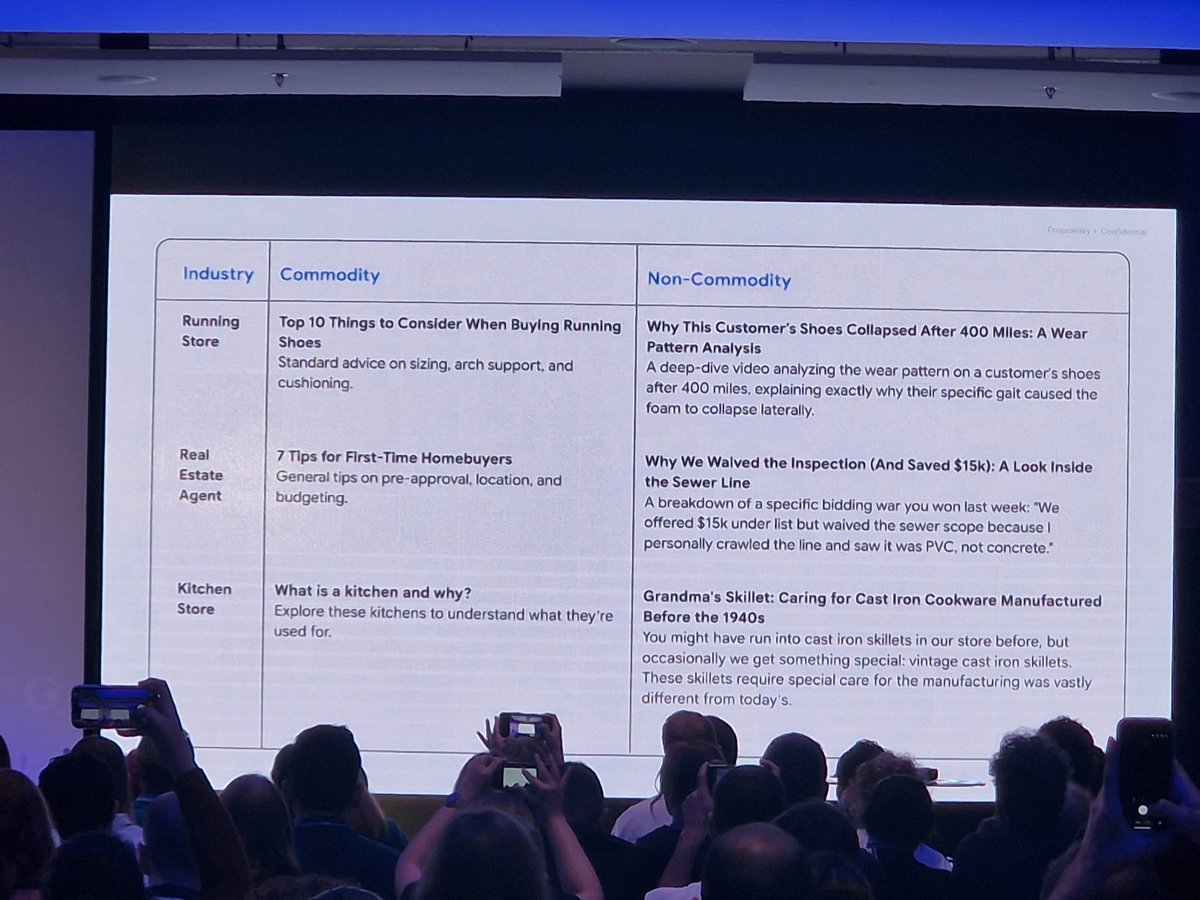
| Business | Commodity | Non-commodity |
|---|---|---|
| Running store | “Top 10 things to consider when buying running shoes” | A video analyzing the wear on a customer’s shoes, which collapsed after 400 miles, explaining why their gait crushed the foam |
| Real estate agent | “7 tips for first-time homebuyers” | A breakdown of a real bidding war: why the offer waived the inspection and saved $15k |
| Kitchen store | “What is a kitchen and why?” | Caring for cast iron cookware made before the 1940s |
The left column is exactly the kind of text an AI produces by the thousand in an afternoon. The right column depends on something only that business saw. For anyone running a company site, the exercise is to look at your own blog and count how many posts would fit in the left column.
Do core updates assess the page or the whole site?
Here the accounts from people in the room do not match. The We Are Roast recap, repeated by Search Engine Roundtable, records that core updates target content at the page level, not the domain level, which is why some pages on a site go up while others go down.
Nacho Mascort wrote the opposite on his blog: that Gary Illyes “made it clear that core updates look at the site”. Mascort adds his own reading, based on the leaked Google API documents, which mention site-level signals such as siteAuthority. He flags that part as his interpretation.
Google has not published the presentation, so there is no original text to settle it. In practice, both versions lead to the same task: a weak page is a problem, whether because it drops on its own or because it weighs on the site.
How long does it take to recover from a core update?
Recovery from a core update takes 3 to 6 months in the typical case and 6 months to a year in the worst case, according to the slides Gary Illyes showed with data from internal analyses. Both accounts agree on this point. We Are Roast also recorded that a core update takes 2 to 4 weeks to finish rolling out, while a spam update takes 1 to 2 days.
What is Nacho Mascort’s quality audit skill?
The google-quality-audit skill is a tool Nacho Mascort built for Claude and Codex, the coding assistants from Anthropic and OpenAI. It audits pages against the four pillars of quality, applies the commodity content test and cross-checks the result with signals from the leaked Google API documents, producing a report by page and by page type. The download is free, with an email signup, on his post.
The article also brings a number from outside Google: a study by Ahrefs estimated that 74.2% of new pages from April 2025 contained AI-generated content.
Summary: what to do on Monday
Google said in Barcelona that the volume of new content explains the run of spam updates in 2026, that it now uses AI to detect spam, and that scaled content worries it more than link spam. The quality criteria remain the four pillars: effort, originality, talent or skill, and accuracy.
- List the pages published in the last 12 months and mark the ones that would fit the “commodity” column on the slide.
- For each one, decide: add something only your business has (data, a case, a photo, a test), merge it with another page, or remove it.
- If you publish with AI, define who reviews it and what that person adds before it goes live.
- If your site dropped in a core update, work with the 3 to 6 month window Google showed, not with recovery the following week.
- If you depend on Discover, watch your traffic there closely: it was the channel named at the event as the target of the rise in AI slop.
To build your content calendar around a few strong topics instead of many thin posts, see the piece on topical authority and content clusters. For the AI search side of the same logic, read what GEO is.